

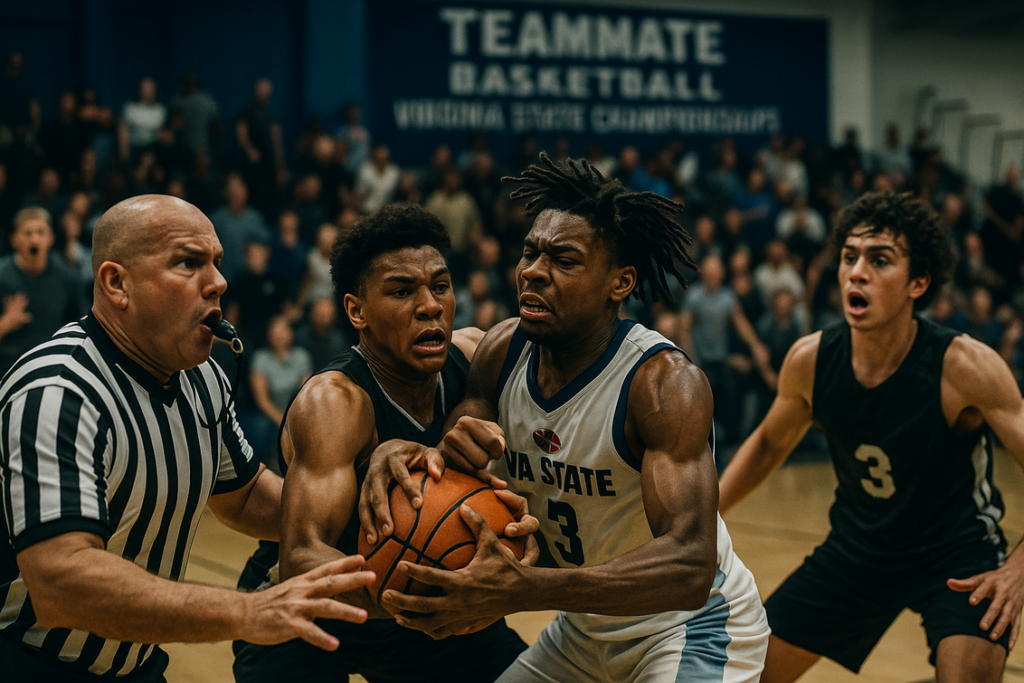
crssblog.com – The Henrico Sports and Events Center, usually a showcase for rising basketball talent, became the scene of chaos during a June 6 state tournament game. A heated confrontation erupted late in the matchup, turning a competitive atmosphere into a disturbing brawl that stunned players, families, and officials. Reports confirm that both a referee and a player suffered injuries, leaving many to question how a youth-centered event at the Henrico Sports and Events Center spiraled so quickly into violence.
This incident has sparked intense debate about behavior at high-stakes games, responsibility for crowd control, and the pressures young athletes face. As the Henrico Sports and Events Center rebuilds trust after this weekend disruption, the wider basketball community must confront uncomfortable questions. How did a place designed for teamwork, discipline, and community pride instead become a headline for conflict and injury?
What Really Happened at the Henrico Sports and Events Center?
Witnesses at the Henrico Sports and Events Center describe a tense matchup in the Virginia state tournament that steadily grew more emotional. Every call from the officials drew louder reactions from benches and fans. As the game approached its final moments, that emotional temperature boiled over. A hard foul on the court reportedly triggered heated words, followed by shoving, then a full-scale scuffle involving players, coaches, and even some spectators.
In the middle of the clash stood the officiating crew, whose job suddenly shifted from managing a game to protecting themselves. One referee was injured while trying to separate individuals, highlighting the physical risk officials face whenever order breaks down. At the same time, at least one player was also hurt, turning a night meant to showcase skill at the Henrico Sports and Events Center into a night of medical evaluations and shaken nerves.
Security and tournament organizers stepped in to contain the disturbance, yet the damage had already been done. Parents rushed onto the floor, children cried in the stands, and social media posts began flying within minutes. By the time the dust settled, the Henrico Sports and Events Center was no longer trending for its state-of-the-art courts or strong youth participation. Instead, it became a symbol of how quickly a sports celebration can degenerate when emotions replace respect.
Why Tensions Explode at High-Stakes Youth Games
The brawl at the Henrico Sports and Events Center did not occur in a vacuum. Youth sports has seen rising intensity from athletes, coaches, and supporters. Tournament games double as scouting showcases, scholarship auditions, and social media content. Every play feels magnified, every whistle interpreted as life-changing. Under these conditions, it only takes one controversial moment to ignite deeper frustrations simmering beneath the surface.
Adults often underestimate how much pressure young athletes carry. Players internalize expectations from trainers, parents, and peers, especially in venues as impressive as the Henrico Sports and Events Center. When fatigue sets in and emotions spike, self-control grows harder to maintain. Coaches sometimes mirror that tension with animated protests, which can signal to players and fans that officiating is an enemy instead of a neutral part of the game.
Personal experience covering youth tournaments has shown me a repeated pattern. Conflict rarely begins with fists; it starts with unchecked language, taunting, and escalating glares. When that behavior is tolerated, physical confrontation becomes more likely. The Henrico Sports and Events Center incident reflects this pattern painfully well. That night, verbal disputes evolved into contact, leading directly to injuries that overshadowed all the positive work usually done at the facility.
How the Henrico Sports and Events Center Can Lead Reform
Even though this brawl cast a harsh spotlight on the Henrico Sports and Events Center, the story does not need to end with embarrassment. The complex can become a model for reform by tightening security presence during high-stakes games, setting clear conduct expectations, and backing officials when they enforce boundaries. Pre-tournament briefings for coaches and parents could emphasize consequences for aggressive behavior, while visible codes of conduct displayed across the Henrico Sports and Events Center would remind everyone that competition never outranks safety. From my perspective, the most powerful change would involve a cultural reset: rewarding teams, fans, and staff for sportsmanship as actively as they are praised for trophies. If that happens, this painful episode could become a turning point, pushing local basketball toward a healthier future.