

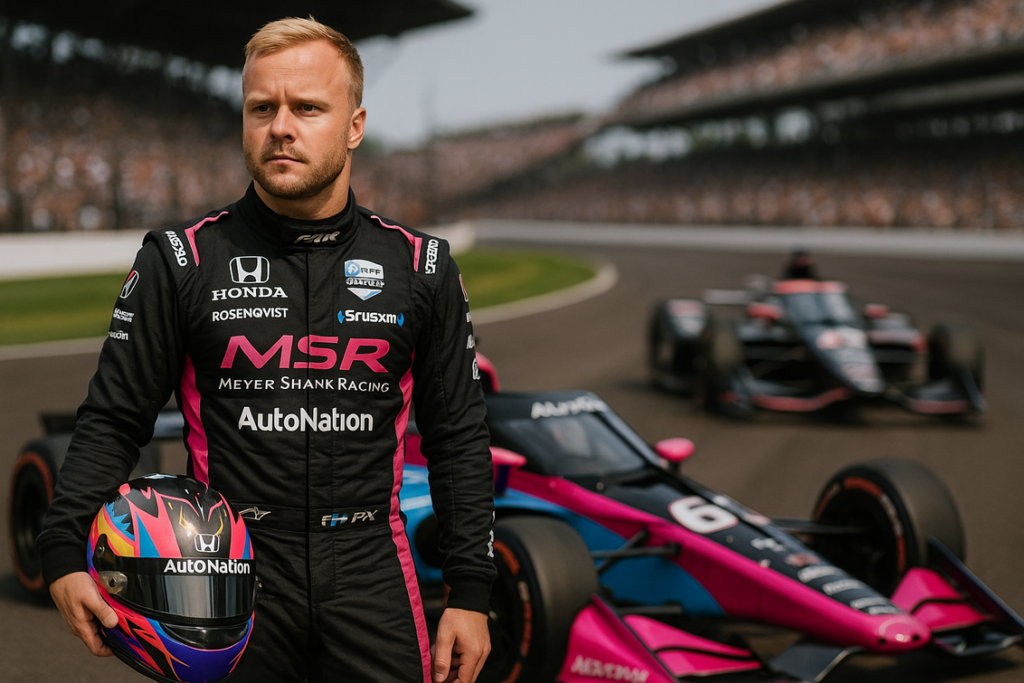
crssblog.com – In INDYCAR, context is not a footnote; it is the headline. Nowhere is this clearer than in the sudden surge of Indy 500 champion Felix Rosenqvist, whose power ranking leap reminds us that raw speed means little without the right surrounding conditions. Track type, strategy, weather, and team chemistry all interact to build or break a weekend.
Rosenqvist’s recent Indy 500 triumph with Meyer Shank Racing underlines how context can transform a contender into a star. Just weeks earlier, his results looked inconsistent, almost erratic. Yet under the unique spotlight of Indianapolis, every variable aligned. To understand his rise in the power rankings, we must explore how context reframes performance, expectations, and even a driver’s legacy.
Context as the Hidden Engine of Performance
On paper, power rankings appear simple: list the drivers from strongest to weakest. Reality refuses to fit that neat order. Context turns this list into a living organism. A driver like Felix Rosenqvist can hover in the midfield one weekend, then dominate the biggest race of the season the next. The numbers change, but the underlying story is woven from track layout, team preparation, and mental resilience.
Oval circuits, street courses, and permanent road courses each demand specific strengths. A ranking that ignores this context is misleading. For instance, a driver highly rated after multiple street races might slide once the series reaches a fast superspeedway. Nothing about their talent changed. What changed was context: aero balance, tire behavior, even how traffic compresses or spreads the field.
This is why serious fans and analysts treat rankings less as verdicts and more as conversation starters. They reflect who thrived within a particular set of conditions, not pure talent in a vacuum. Context adds the missing layers. It explains why a champion might look ordinary on one Sunday, then untouchable the next. It is the invisible engine that shapes every high or low on the chart.
Felix Rosenqvist’s Surge Through a Context Lens
Felix Rosenqvist’s path has never been linear. His history across teams shows how much environment molds results. At times, his pace placed him among the quickest over a single lap. Yet the final standings often failed to reflect that speed. The issue was not simple inconsistency. Instead, context frequently worked against him: reliability issues, strategy gambles, untimely cautions, or setups misaligned with his driving style.
With Meyer Shank Racing, the context finally fits. The team approached Indianapolis with a clear plan, a car tailored to his strengths, plus a culture that trusts his judgment. Indy’s unique rhythm suits his precise, confident approach in traffic. Under that specific context, he did not just look quick; he looked inevitable. Power rankings reacted instantly, vaulting him from relative uncertainty into elite conversation.
From my perspective, this surge is less surprise and more overdue validation. Rosenqvist always carried the raw ingredients. Context supplied the missing recipe. His Indy 500 win proves how a driver’s narrative can pivot when support structure, strategy calls, and personal confidence reach sync. Rankings follow the results, but the deeper story is about finally aligning skill with the right environment.
How Context Rewrites INDYCAR Power Rankings
Context will continue to reshape INDYCAR power rankings long after the champagne from Indianapolis dries. As the series moves between tight streets, sweeping ovals, and technical road courses, each driver faces a shifting puzzle. Rosenqvist may shine brightest on high-speed ovals, while others reclaim ground on twisty circuits. Fans who ignore context see chaos. Those who look closer witness a layered competition where adaptability counts as much as raw pace. To me, that is the real joy of following these rankings. They become a dynamic map of how individuals and teams navigate evolving conditions. In the end, context does more than explain who rises or falls; it invites us to think deeper about what performance truly means, both on track and beyond.